
The Great Dispersion: AI Will Scatter Programmers, Not Eliminate Them
Published:
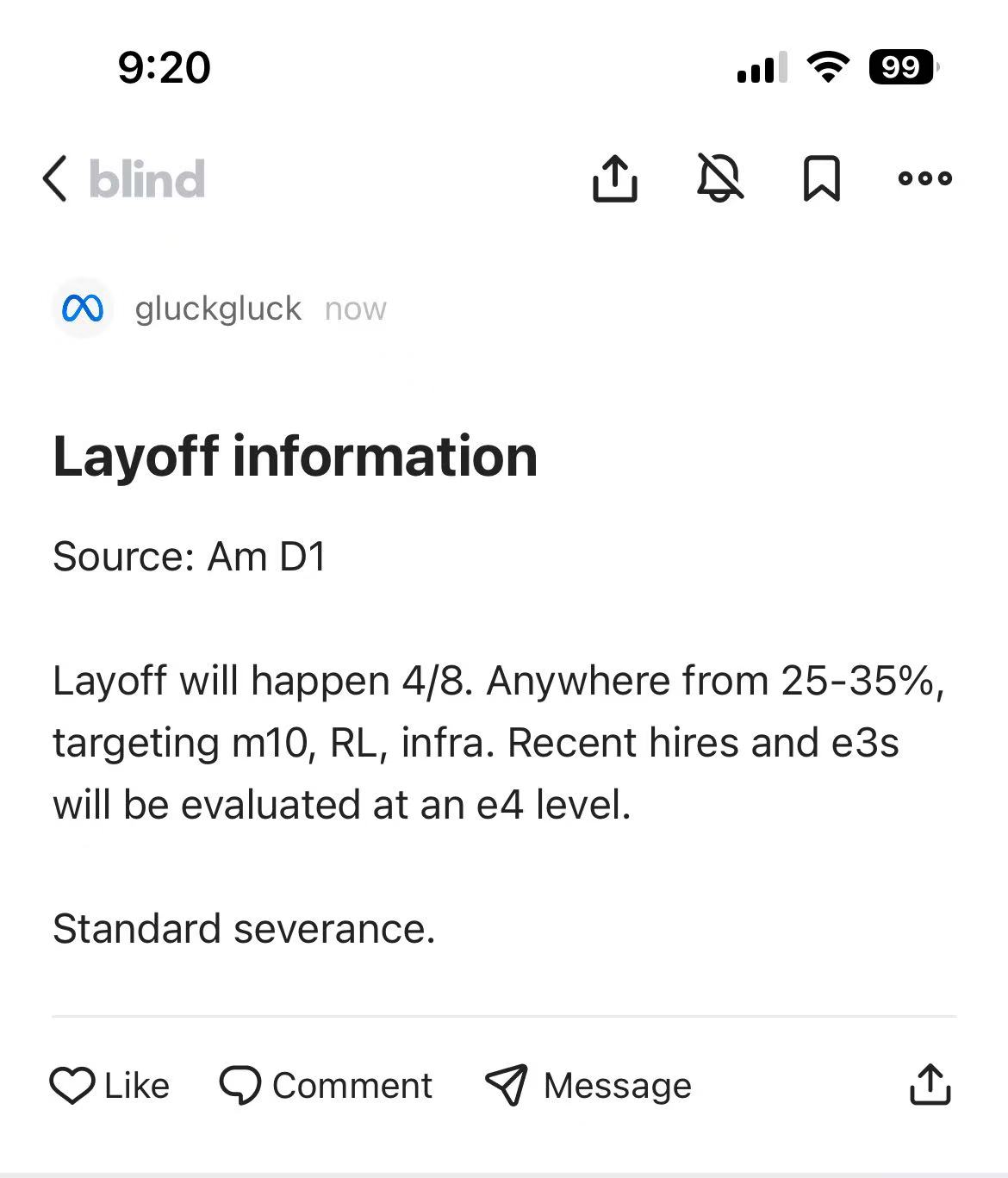
Another round of layoff rumors from Meta — 25–35% cuts targeting infra, RL, and M10, with E3s re-evaluated at E4 standards. Unverified, but the pattern across Big Tech is unmistakable.
Are programmers going extinct? No. But the profession is about to be restructured.
Layoffs Are a Big-Company Story
This is not the death of software engineering — it is the end of hyper-concentration. For two decades, engineers piled into a handful of companies chasing $300K+ TC and FAANG prestige. These companies hired far beyond actual need because hoarding talent was itself a strategy.
Now AI changes the math. 10 engineers with Claude Code can do what 30–50 did before. Big Tech is overstaffed, and they know it.
But the world has more software problems, not fewer. The gap is at the millions of SMBs that always needed custom software but could never afford an engineering team.
From Concentration to Dispersion
Big Tech shrinks. The remaining engineers will be senior, productive, and AI-augmented. Mass new-grad hiring for internal tooling is over.
SMBs gain access. One developer with Claude Code can now build what used to require a small team. A logistics company, a hospital, a manufacturer — they can finally afford one or two engineers for custom solutions. I built GuardClaw — a full-stack AI safety monitor with a native macOS app, React dashboard, and real-time agent interception — largely solo with AI-assisted coding. A project like this would have needed a small team not long ago.
But they still need someone. AI tools are powerful, not autonomous. You still need a human who understands requirements, architecture, security, and deployment. A business owner cannot just say “build me an ERP” and get a production system. They need a professional who knows what to ask and how to validate.
The aggregate math works. Each SMB needs 1–3 engineers, not 20. But millions of SMBs with zero engineering capability times one or two hires each = enormous distributed demand.
Mean Reversion
Engineers concentrated in a few companies → salaries bid to irrational levels. Engineers spread across thousands of employers → compensation normalizes. Not poorly paid — just no longer an anomalous outlier. More like electrical or civil engineering: respected, well-compensated, distributed.
The Wheel of History
Power tools didn’t eliminate carpenters — they made carpentry accessible to smaller shops. Accounting software didn’t eliminate accountants — it redistributed them.
AI will do the same to software engineering. The hyper-concentration in Big Tech was a historical anomaly. The programmers who thrive will be those who adapt to AI tools, who can be the sole engineer at a company, and who translate business needs into solutions without three layers of management.
This is not the end of programming. It is the end of programming as a gold rush. What follows is not abandonment — it is settlement.